A backtester tells you what a strategy would have done. A journal tells you what you actually did. One without the other leaves holes. Here is a five-step loop that closes them.
By Wickform Team3 min read
In short
A backtester answers "does this setup work?" A journal answers "am I trading it the way I think I am?"
On their own, each one hides something important. Together they become a loop: test, record, review, adjust.
Wickform was built so that loop happens in one place, on every trade.
Two different questions
Most new traders buy a backtesting tool first, then a journal later, and treat them as separate hobbies. But they answer two halves of the same question.
The backtester asks: if I trade this setup on past data, what happens? It's about the strategy.
The journal asks: when I trade it, what do I actually do? Do I follow my rules, size properly, take profits where I planned? It's about you.
A strategy only makes money when both answers are good.
What a backtester alone misses
Why a trade won or lost. A list of results tells you the score, not the reason.
Which trades really belonged to the setup. Without tagging each one, the bad trades you took out of boredom dilute the good ones.
How you managed the trade. Did winners run, or did you cut them at 1R every time?
What a journal alone misses
Sample size. Live trading gives you a handful of setups a week. It takes months to learn anything.
Clean conditions. Every live trade carries real money and real nerves, so it's hard to tell a bad setup from a bad day.
What-ifs. A journal records what you did. It can't re-run your entries with a different stop to show what you could have done.
A five-step loop
Write the setup down as a playbook. Three to five rules you can tick off: which level, which session, where the stop goes, where the target goes.
Replay at least 30 trades. Bar by bar, with the future hidden. Jump to the sessions you trade so you're not waiting through dead hours.
Journal every trade as you take it. Pick the playbook, tick the rules you followed, give it a grade. Screenshots at entry and exit happen on their own.
Read the breakdowns. Results by session, hour, weekday, playbook and grade. Look at MAE and MFE: how far each trade went against you and for you.
Change one thing, then repeat. Drop the worst session, move the stop, or tighten one rule. Then replay another 30.
One month, reviewed
Here is that loop on a sample month: the Wickform demo journal, 38 made-up trades on a 50K evaluation account in October 2026, with two playbooks (a liquidity-sweep reversal and a trend continuation). No real market is in it, and you can open it yourself.
The month made +$2,845 with a 55% win rate. The breakdowns say much more than that:
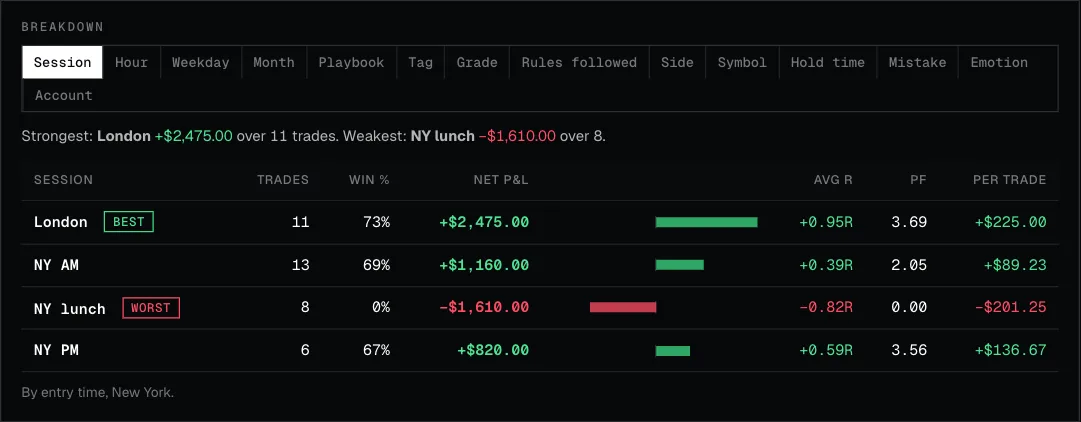
London made most of the profit. NY lunch lost every trade.
London did most of the work: 11 trades, 73% won, +$2,475. NY lunch lost all 8 of its trades. That's a rule worth testing next: no trades at lunch.
Mistakes had a price. Trades tagged Moved stop cost $820, and two revenge trades another $640.
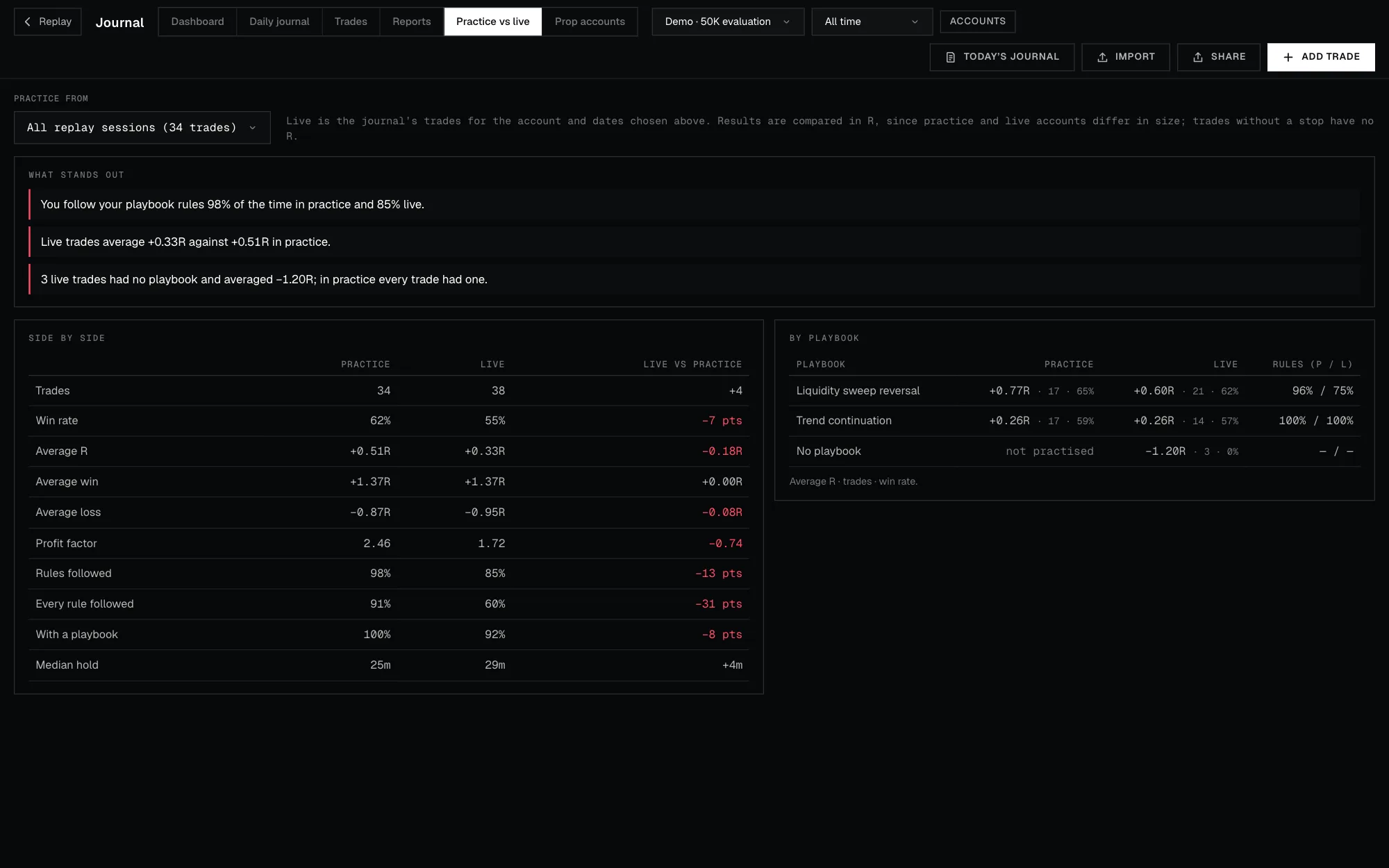
Practice and live disagreed. In replay the same playbooks averaged +0.51R with 98% of the rules followed. Live: +0.33R and 85%. The setups work; the execution leaks.
Practice vs live: the same playbooks, replayed and traded.
One honest warning: one good month is a hypothesis, not proof. Replay a different month before you change anything with real money. That's exactly why the loop repeats.
Key takeaways
Backtesting tests the strategy. Journaling tests you. You need both answers.
Write the setup as rules, replay 30 trades, journal each one, read the breakdowns, change one thing.
Look past the total P&L: sessions, mistakes and the gap between practice and live usually hold the next improvement.
FAQ
How many trades do I need before the numbers mean anything?
Thirty is a sensible first checkpoint, and more is better. Under that, one lucky trade can swing everything. Keep replaying across different months, not just the one that looked good.
Should I journal backtest trades as seriously as live ones?
Yes. The point of replay is to rehearse the exact process you will use live, including grading and rule checks. Lazy journaling in replay becomes lazy journaling with money.
Can I log a setup I saw but did not take?
Yes. Wickform has a missed-trade log. It stays out of your stats, but shows what the trade would have made, which is useful for spotting hesitation.