Write a playbook you can actually test
A strategy you can't write down can't be tested. Turn your setup into a few rules you can tick off, starting from an example you can copy.
- Why a backtest starts with written rules
- The five parts every testable playbook needs
- A complete example you can copy and adapt
- How to spot rules that are too vague to test
Why rules come first
If the setup only lives in your head, every trade becomes a judgement call made with hindsight nearby. At the end you'll have results, but you won't know what they're results of.
Written rules fix that. They let you check, trade by trade, whether you followed the plan, and later separate "the setup doesn't work" from "I didn't trade the setup".
The five parts of a playbook
- Where and when. The market and the session or hours you trade it.
- The trigger. The specific thing that has to happen before you consider a trade.
- The entry. Exactly what makes you click buy or sell.
- The stop. Where you're wrong, decided before you enter.
- The exit plan. Targets, partials, breakeven and trailing, also decided before you enter.
Example: Asia range sweep
A popular intraday setup: price runs above or below the range it made during the Asia session, fails, and snaps back inside. Written as a playbook, it looks like this:
- The Asia high or low (or the previous day's high or low) is swept by a wick.
- The 5-minute candle closes back inside the range.
- The entry happens during the London or New York killzone.
- The stop goes beyond the wick that made the sweep.
- The target is the opposite side of the range, at 2R or more.
Each rule is a yes or no. That's the test: if two traders could disagree on whether a rule was met, it needs rewriting.
Wickform draws the Asia and London highs and lows, and the previous day's range, for you, and marks them when they're swept. You spend your attention on the decision, not the drawing.
Add it to Wickform
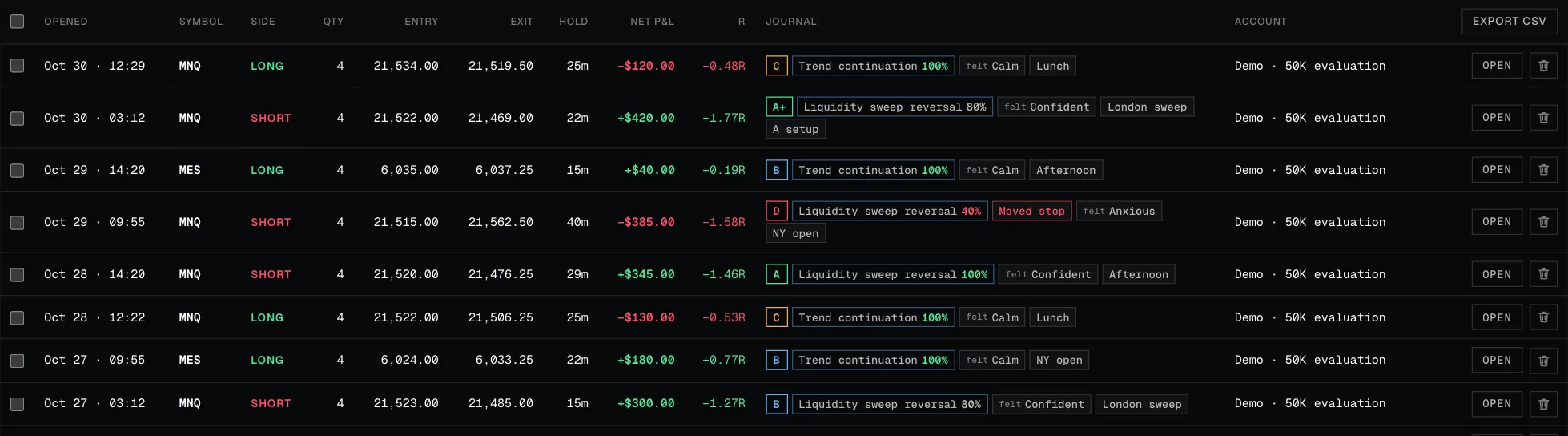
Open the journal's Playbooks & templates and add your setup with its rules. When you take a trade, pick the playbook and tick the rules you actually followed, then give the trade a grade.
Later, the Rules followed and Playbook breakdowns show whether trades that followed every rule did better than the ones that cut corners. That's usually the first useful thing a backtest tells you.
Rules that can't be tested
Watch for words that hide a judgement call:
- "Strong" move, "clean" level, "good-looking" candle. Strong compared with what?
- "Wait for confirmation." What, exactly, confirms it?
- "Take profit when it feels right." Decide the target before the entry.
Replace each one with something you can see on the chart: a close beyond a level, a candle size, a time of day.
- Write the setup down before you test it.
- Cover where, trigger, entry, stop and exit plan.
- Every rule should be a clear yes or no.