Backtester or journal? Why a strategy needs both
A backtester tells you what a strategy would have done. A journal tells you what you actually did. One without the other leaves holes. Here is a five-step loop that closes them.
Read →All-in-one, prop-firm, psychology-first or free: ten trading journals compared honestly, with who each one is for and what it costs.
 By Wickform Team7 min read
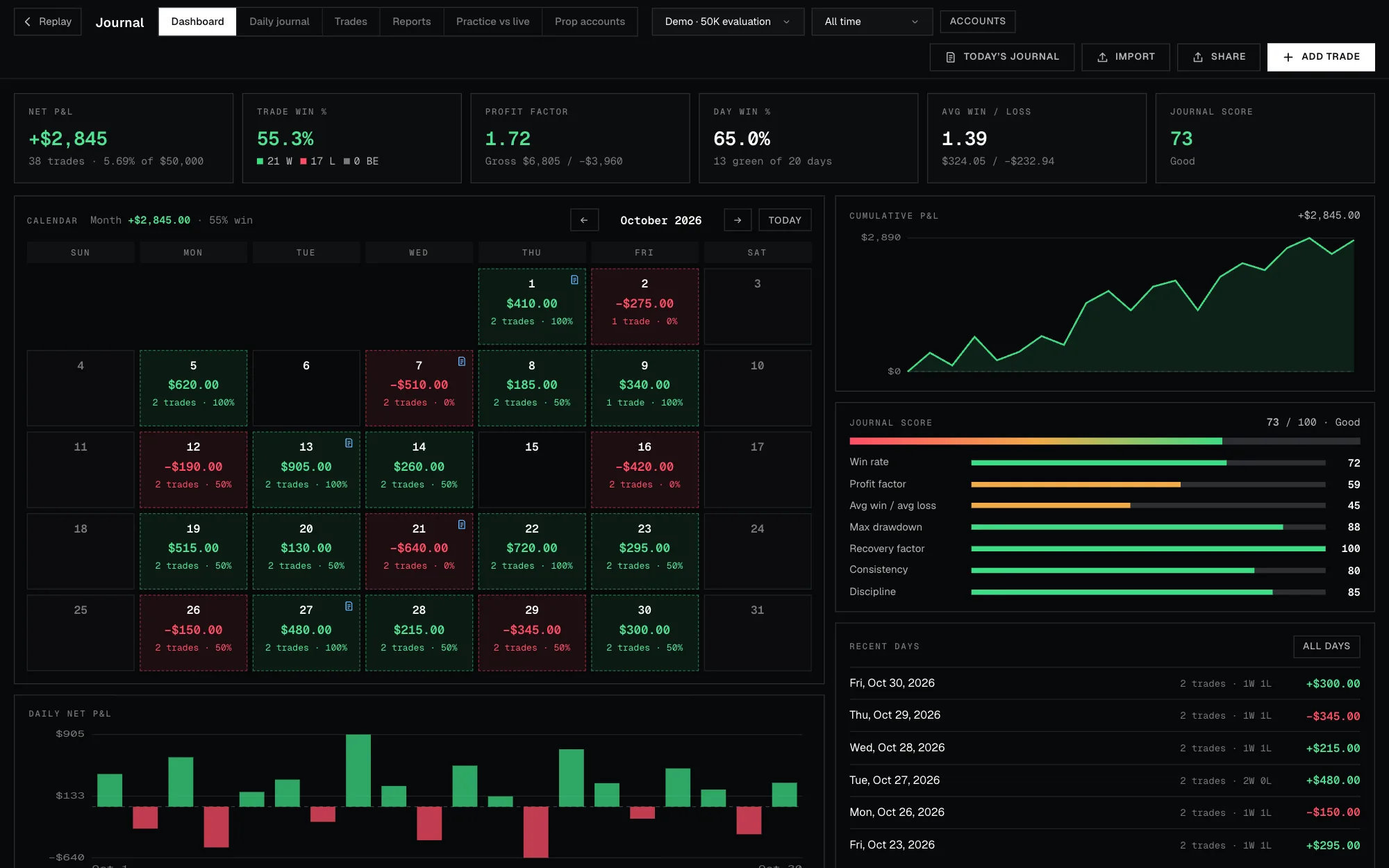
We make Wickform, which is on this list. We've tried to be fair: every journal below is the right pick for someone, and we say where Wickform isn't. Prices are in US dollars, checked on 19 November 2026 on each company's own site where it showed them; they change often, so check before you buy.
A trading journal earns its place if it makes reviewing your trades easy enough that you actually do it. We looked at how trades get in (broker sync, file import or typing), what it shows you (by setup, session, mistake, emotion), whether it helps with rules and discipline, which markets it supports, how it treats your data, and what it costs to start.
| Journal | Best for | Starts at |
|---|---|---|
| TradeZella | The most complete all-in-one journal | $35 / month |
| Wickform | Prop futures traders: journal, rules and replay | Free plan |
| TraderSync | Automatic imports and AI feedback | $29.95 / month |
| Edgewonk | Trading psychology and discipline | $35 / month or $197 / year |
| Tradervue | A proven journal with a free plan | Free plan |
| TradesViz | Hundreds of stats and charts | Free plan (stocks) |
| Trademetria | Budget multi-asset journaling | Free plan |
| FX Replay | Journaling your backtests | Free plan |
| TradeNote | Open source, self-hosted | Free |
| A spreadsheet | Total control, zero cost | Free |
TradeZella is one of the most popular journals for active traders. It syncs with 500+ brokers, has 300+ reports, MFE / MAE and best-exit analysis, prop-firm account sync, notebooks and playbooks, plus backtesting and replay of your real trades on higher plans. Its AI reviews your sessions and tags trades.
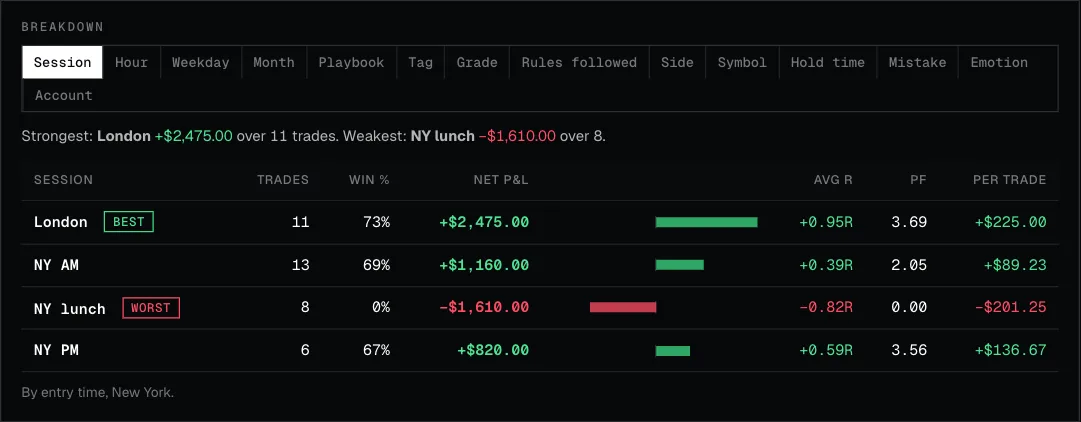
Wickform is built around prop evaluations and funded accounts. It imports trades from Tradovate, NinjaTrader 8, Rithmic, TopstepX, Interactive Brokers, MetaTrader 5 or any CSV, tracks each account against its firm's rules (daily loss, drawdown, consistency), and shows your odds of passing from your own trades. Every trade gets a playbook, mistakes, a grade and screenshots, and you can practise the fixes on bar replay and compare practice with live.
TraderSync connects to a very wide range of brokers, imports trades automatically, and uses its AI assistant to point out patterns in your results. It covers stocks, options, futures, forex and crypto, with exit-efficiency analysis, a strategy checker, trade planning, and market replay for practice.
Edgewonk focuses on the trader as much as the trades. You track emotions, mistakes, checklists and your routine, and its reports show what tilt and rule-breaking cost you. Every subscription includes every feature, with unlimited journals, accounts and trades across all markets.
Tradervue is one of the longest-running trading journals. It imports from many brokers, draws your entries and exits on price charts, and has more than 100 reports on its paid plans, plus mentoring and trade sharing.
TradesViz offers hundreds of statistics and charts, auto-plotted TradingView charts for each trade, a simulator, options tools and AI features, with a REST API and MCP connector for your own tools.
Trademetria is a straightforward journal for stocks, options, futures, forex, crypto and CFDs, with a daily journal, reports and a simulator on paid plans.
FX Replay is a backtesting platform first, but its paid plans include a journal with screenshots, checklists and strategy analytics, so your practice trades are reviewed where you made them.
TradeNote is an open-source trading journal you run yourself (for example with Docker). Your data stays on your own server, and you can change the code.
Google Sheets, Excel or Notion can be a perfectly good journal if you're disciplined. You choose every column and pay nothing.
It depends on how you trade. TradeZella is the most complete all-rounder, TraderSync is strongest on automatic imports and AI, Edgewonk on psychology, and Wickform is built for prop futures traders tracking evaluation rules.
Tradervue, TradesViz (for stocks), Trademetria and Wickform all have free plans with limits. TradeNote is free and open source if you can host it yourself, and a spreadsheet works for very few trades.
One that tracks each evaluation's rules, such as daily loss, trailing drawdown and consistency. Wickform is built around that, with presets for popular futures prop firms; TradeZella and Edgewonk also support prop accounts.
If you want to improve, yes. Without one you remember your best and worst trades and forget the rest. A journal shows which setups, hours and habits actually make or lose you money.
Automatic sync saves time, but it means sharing broker access. Importing the report your platform exports, as Wickform does, keeps your broker login private and takes a minute a day.
 Test + review
A backtester tells you what a strategy would have done. A journal tells you what you actually did. One without the other leaves holes. Here is a five-step loop that closes them.
Read →TradingView Replay vs WickformTradingView's Bar Replay is where most traders first rewind a chart. Here is what it does well, what a real backtest needs on top of it, and when each tool is the right pick.
Read →