Read your results: breakdowns, MAE / MFE and exits
Thirty trades in, the numbers start to talk. How to read them, and how to turn them into your next change instead of a new strategy.
- Which five numbers to read first
- How breakdowns show where your edge lives
- What MAE and MFE say about your stops and targets
- How to use the exit optimizer without fooling yourself
Throughout this lesson we use the demo journal: 38 made-up trades on a 50K evaluation account in October 2026. Nothing in it comes from a real market, and you can open it yourself and follow along.
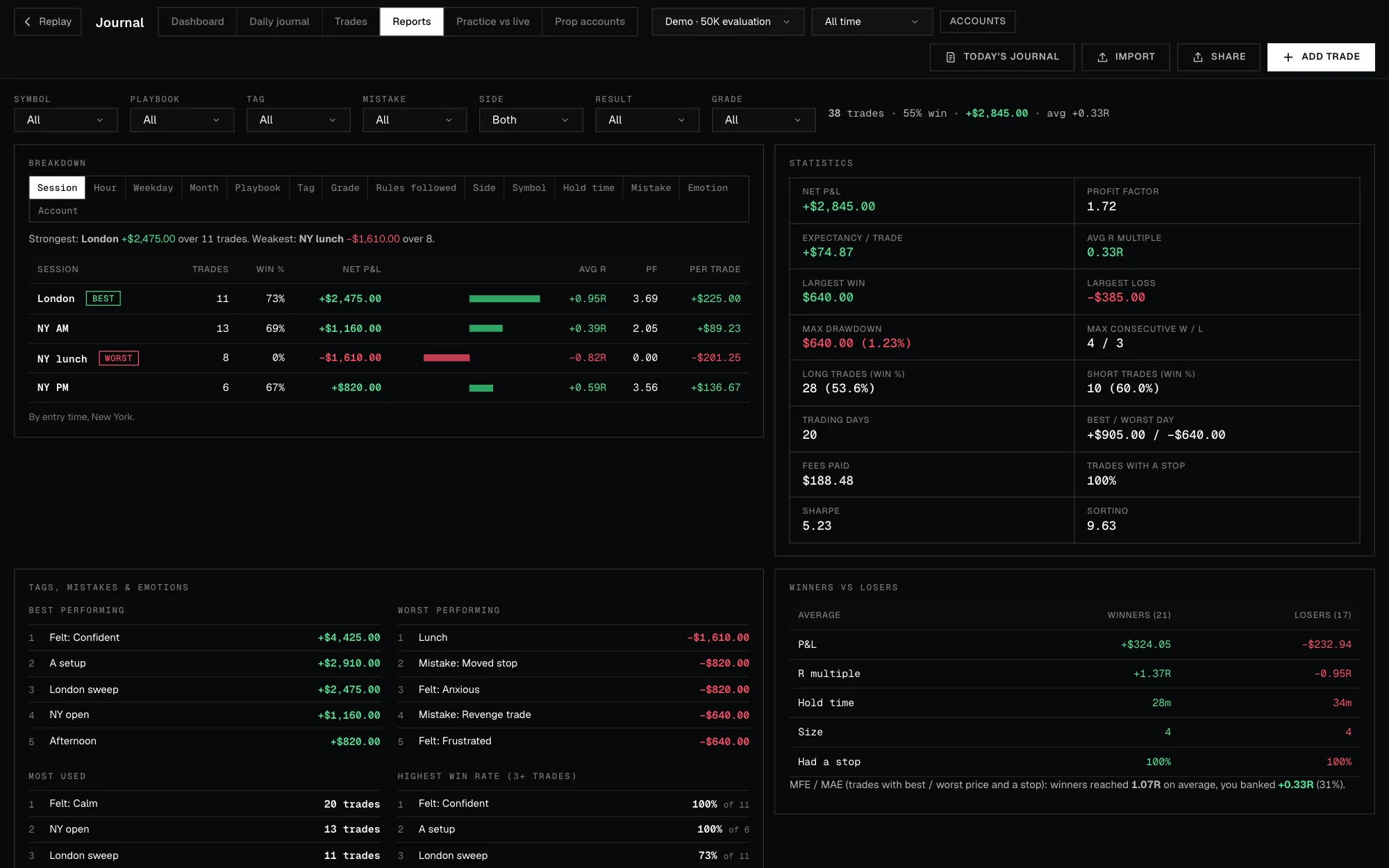
Start with five numbers
- Trades: 38. Enough to start reading, not enough to be sure.
- Win rate: 55%. Only meaningful next to the average win and loss.
- Average R: +0.33R per trade. The single most useful number: what an average trade earns for each unit of risk.
- Profit factor: 1.72. Gross profit divided by gross loss. Above 1 makes money.
- Max drawdown: $640. The deepest dip from a peak. Ask yourself whether you could sit through it live, and how it compares with your account's max loss limit.
Find where the edge lives
The totals hide the story. Split the trades by session, hour, weekday, playbook, grade, rules followed, mistake and emotion.
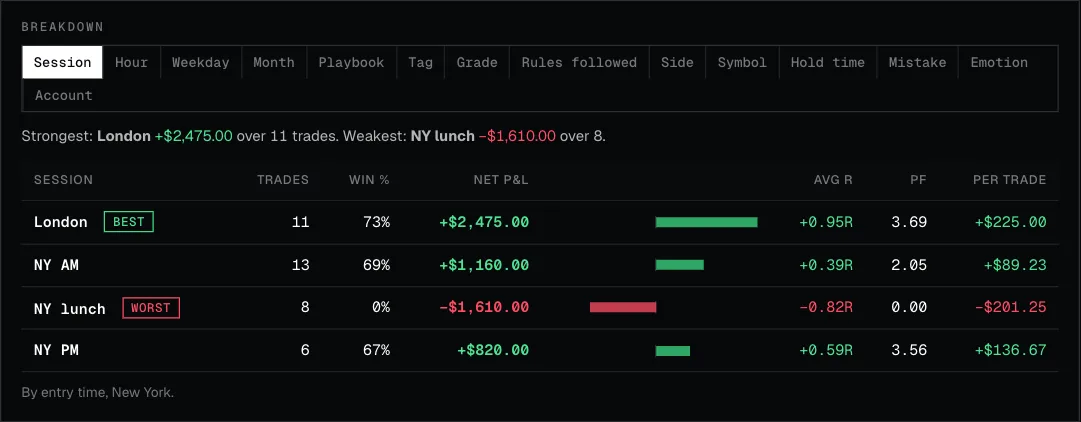
Here, London did most of the work: 11 trades, 73% won, +0.95R on average. NY lunch lost all 8 of its trades. The mistakes report gives part of the reason: two of them were tagged Revenge trade, taken right after a losing morning. Small samples per session, so treat it as a lead to test, not a conclusion.
Read MAE and MFE
MFE (maximum favourable excursion) is how far a trade went in your favour before it closed. MAE (maximum adverse excursion) is how far it went against you. Wickform fills them in from your bars, or you can type the best and worst price yourself.
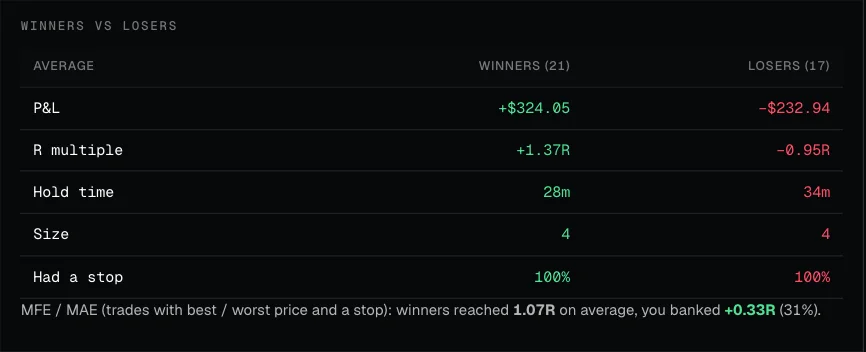
- Winners reached 1.07R in their favour on average, and the average trade banked +0.33R. Some of what the trades offered is being left on the table.
- Losers were held longer than winners (34 minutes against 28). Hoping a loser comes back is a common, expensive habit.
- The worst trade tagged Moved stop lost 1.6R. A stop that stays where you put it caps every loss at about 1R.
Test other exits
In replay, the exit optimizer re-runs your own entries with 36 combinations of stop size and target, using the same fill rules as replay. It needs the bars, so it works on replay sessions, not on journal trades without bars.
Be careful with it: the best cell on one month is often luck. Prefer a change whose neighbours in the grid also do well, and confirm it on a different month.
Turn it into one change
Write down the one change you'll test next, such as "no trades at NY lunch" or "the stop never moves". Then practise a fresh month on replay with only that change, and check the Practice vs live tab: if the change holds up in practice but not live, the problem is execution, not the plan.
- Read trades, win rate, average R, profit factor and drawdown first.
- Breakdowns show where the edge lives; MAE / MFE show what your exits leave behind.
- Change one thing, and confirm it on a different month.